Burnout gets admired. Busy gets rewarded. Even retirement comes with a quiet expectation that you’ll fill it with something impressive.
Which makes deliberately stopping harder than it sounds, and more necessary than it’s ever been.
We’re not scientists. We just watch the same thing happen every time someone arrives in the mountains. Shoulders drop. The phone gets forgotten. Somebody belly laughs with a person they met an hour ago.
Turns out a fair bit of that is measurable, and the research is more specific than we expected.
Here’s what the science actually says:
The mental chatter starts to slow
The mind has a habit of circling problems long after useful thinking has ended. Psychologists call this rumination: repetitive thought focused on what went wrong, what might go wrong or what we should have done differently.
Arriving in the mountains seems to help that thought pattern shift. We notice it ourselves when we’re out guiding, we see it in our guests.
Ninety minutes is the number, as it happens. Stanford University put people on ninety-minute walks and the ones who walked in nature came back with measurably less rumination, that loop of thought you can’t put down, and less activity in the part of the brain that runs it. The ones who walked the same ninety minutes beside a road came back the same as they went in.
Nature might not solve your inbox. It simply stops feeding it.
Out here your attention swings towards whatever’s immediately in front of you. The crunch underfoot. The temperature change when you step into shade. Cloud moving across a peak faster than you’d expect. Those details interrupt the loop and give your thoughts somewhere else to be.
If you spend most days planning, deciding and anticipating what everyone else needs, that quiet lands less like entertainment and more like relief.
Your stress response gets a chance to stand down
When life keeps asking for your attention, the body can remain in a low-level state of readiness. Your sympathetic nervous system—the “fight or flight” side of the equation—helps you respond to pressure. The problem is not that it switches on. It is that modern life does not always give it a convincing reason to switch off.
Nature appears to help create that opening.
One real-world study followed urban adults over eight weeks and measured stress biomarkers before and after time spent outdoors. Cortisol fell beyond its normal daily decline, with the most efficient reduction occurring during nature experiences lasting between 20 and 30 minutes. A 2022 meta-analysis also found that forest-based interventions were associated with modest reductions in systolic and diastolic blood pressure, although results vary by study and individual.
This is the more accurate version of “regulating your nervous system.” You are not flipping a reset switch. You are reducing demands, changing your sensory environment and giving the body more chances to move towards its calmer, restorative state.
And you do not have to earn it with a punishing hike. Sitting beside a lake, walking slowly through trees and pausing to watch wildlife still count.
Awe puts your problems back into proportion
There is a reason big landscapes make us go quiet.
If you ever have the pleasure of meeting our lead guide, Nolan, he might tell you his favourite local story about how Norman Sanson climbed Sulphur Mountain more than a thousand times to read the weather station at the top. Guests always go quiet at that, and it’s never really about Sanson. It’s the thousand.
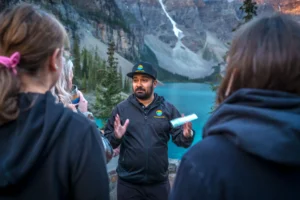
Awe turns up when you meet something too big for your usual frame. Mountains are unreasonably good at it. They were here before your deadlines and they’ll be here long after.
Researchers ran five studies with more than two thousand people and found awe linked to a smaller sense of self-importance and more generous behaviour. In one, people who’d stood in a grove of towering trees were measurably more helpful afterwards than people who’d looked at a tall building.
Feeling small out here isn’t the same as feeling insignificant. It’s closer to being let out of something. For a while you’re not the centre of every problem that needs solving.
Connection starts to feel easier
When the nervous system is overloaded, even good company can feel like another demand. Once the internal noise softens, there is often more room for other people.
Walking side by side removes the pressure of constant eye contact. Shared silence stops feeling awkward when a glacier or a stand of aspens has everyone’s attention. Conversation can move beyond what you do for work and into what you have noticed, remembered or begun to want next.
Research on nature and social connection is still developing, but studies of awe suggest that experiences of vastness can shift attention away from the individual self and towards something more collective. That may help explain why some of the most honest conversations happen on trails, around fires and in the quiet part of the drive home.
Nature does not force connection. It creates better conditions for it.
So, is 24 hours in nature enough to reset your nervous system?
There is no scientifically agreed “24-hour reset,” and anyone promising one is getting ahead of the evidence.
What studies do suggest is that the response can begin surprisingly quickly, and can have measurable positive results.
The studies measure different people, settings and outcomes, so these times should not be added together like a wellness recipe. The broader pattern matters more: nature gives the body repeated cues of safety, space, movement, daylight and sensory calm.
A full day in the mountains simply lets those cues keep arriving.
Four days to let the quiet go deeper
For those drawn to more than a quick escape, Radventures’ Rocky Mountain Wellness Experience creates four unhurried days in the quieter seasons of the Canadian Rockies.
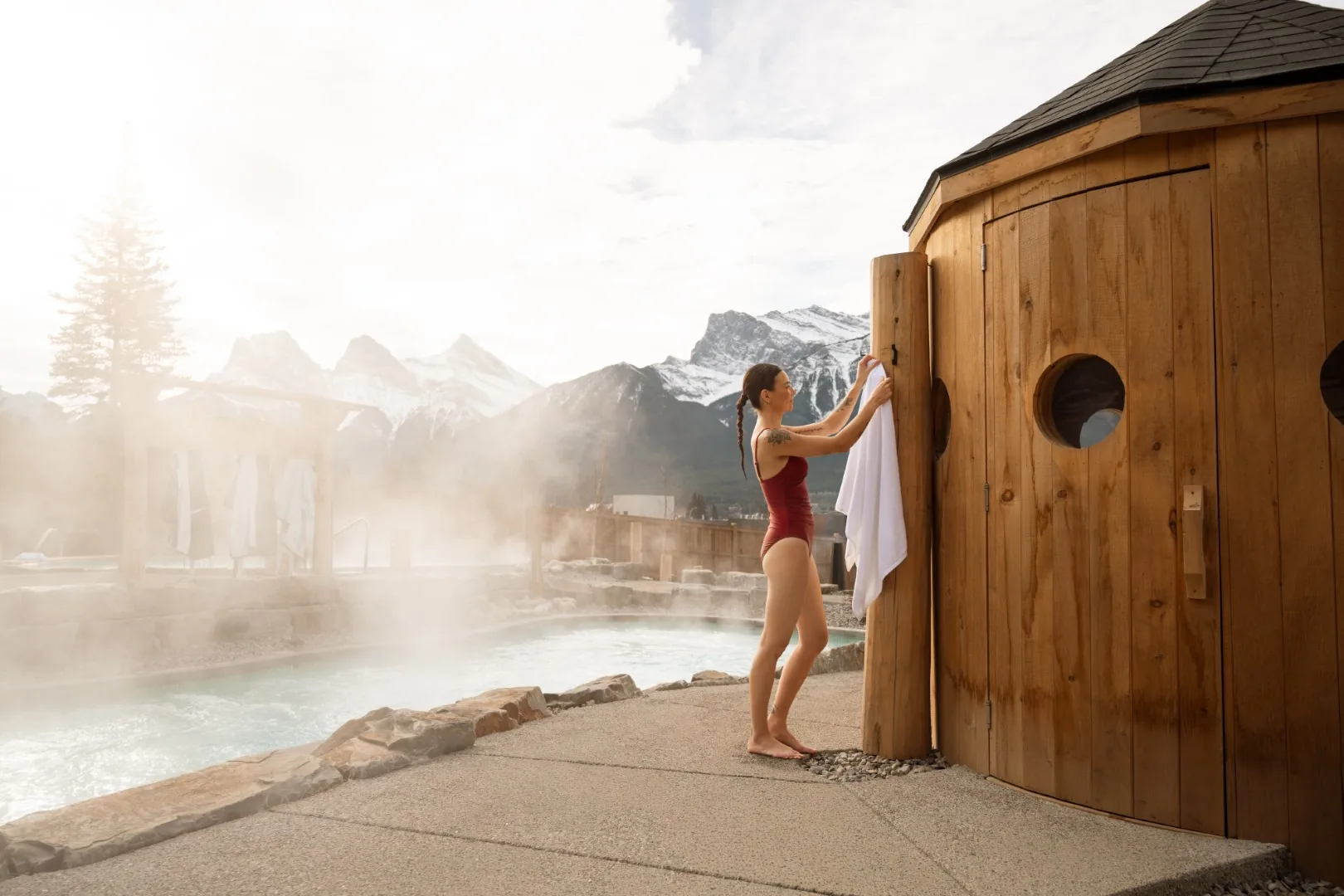
It brings together gentle time outdoors, forest bathing, yoga, an Indigenous Medicine Walk led by a Cree knowledge keeper and the thermal circuit at Everwild Nordic Spa & Hotel. The group is kept small, the activity level is easy and there is space in the itinerary to experience the Rockies without racing through them.
Not a transformation checklist. Not a woo retreat of meditation and breathe work. Just a thoughtfully held few days in a place that makes slowing down feel natural.